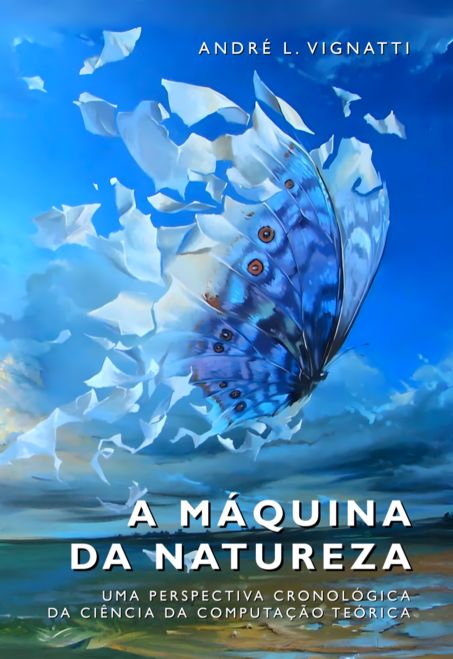
The Machine of Nature
A chronological journey through theoretical computer science.
The book
The Machine of Nature introduces the field of theoretical computer science in an unusual way — not as a branch of engineering, but as a discipline that reaches into philosophy and the natural sciences.
In 2025 it won the Prêmio Jabuti Acadêmico. The Jabuti is Brazil's oldest and most prestigious literary award — running since 1958 — and its academic branch honors the finest scholarly books of the year, so the prize marks this as a standout work of its kind.
Read full descriptionShow less
Written entirely without technical jargon and structured as a story, it is made for everyone — the enthusiast, the expert, and the simply curious.
The story unfolds in three chronological parts. The first traces how and why computer science was born, from the search for truth in Ancient Greece to the limits of formal reasoning. The second covers the classical era of deterministic computation — the machine as a precise, predictable engine of logic. The third enters the modern era, where determinism gives way to randomness, and chance becomes a tool of computation. It is meant to be read in order; skipping ahead is like reading spoilers.
Along the way it explores the limits of manipulating information, the connection between computation and human thought, the parallels between the abstract and physical worlds, and much more.
Details
- ISBN
- 978-65-01-07245-6
- Number of pages
- 423
- Original title
- A Máquina da Natureza
- Publishing date
- 2025
- Award
- Prêmio Jabuti Acadêmico 2025
- Publisher
- Independent
What you'll explore
- The limits of manipulating information Some questions no machine can ever answer, and others would take longer than the age of the universe to solve. Where exactly is the line?
- The connection with human consciousness and thought If thinking is itself a kind of computation, what does that reveal about the mind — and about what machines might one day do?
- Parallels between the abstract and physical worlds Why does pure mathematics describe the physical universe so well, and where does computation sit between the two?
- The theory of biological evolution Evolution read as an algorithm: how blind variation and selection "compute" the staggering complexity of life.
- Determinism and randomness What happens when a machine is allowed to flip coins? Chance turns out to be a surprisingly powerful tool for solving problems.
- The limits of formal science Can every true statement be proved? A century ago, logic ran into walls it could never cross — and those walls turned out to define the field.

André Vignatti
Associate Professor of Computer Science at the Federal University of Paraná (UFPR), in Curitiba, Brazil, where he has taught since 2011. He holds a PhD in Computer Science from the University of Campinas (UNICAMP).
His research spans the design and analysis of algorithms, randomized computation, complex networks, and machine learning. The Machine of Nature grew out of his course "Great Ideas in Theoretical Computer Science."